
Estate Plans

Life insurance is one of the most powerful and flexible tools available to help you build an estate plan. It delivers tax-free death benefits that can create instant liquidity, replace lost income, fund legacies, pay estate taxes, and ensure your loved ones are protected—exactly as you intend.
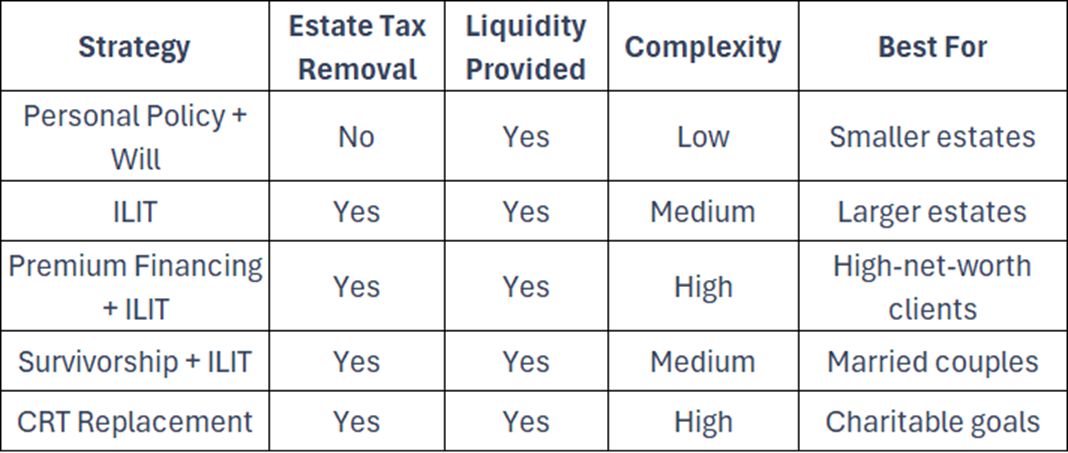
Whether your estate is modest or multi-generational, the right combination of life insurance and strategic planning can help preserve what you’ve worked hard to build and pass it on efficiently. Below is a clear overview of the most effective estate planning strategies that utilize life insurance.
Estate Planning Methods
1. Basic Life Insurance in a Will or Revocable Living Trust
- You own a life insurance policy personally and name your estate, will, or revocable living trust as the beneficiary.
- Benefits: Proceeds help pay estate taxes, debts, funeral costs, or provide immediate cash to heirs.
- Drawback: Policy death benefits are included in your taxable estate, which may trigger estate taxes in larger estates.
2. Irrevocable Life Insurance Trust (ILIT)
- You create an irrevocable trust that owns the life insurance policy (you cannot be the trustee or retain control).
- You gift money to the trust (often using the annual gift tax exclusion) so the trust can pay the premiums.
- Key Advantages:
- Removes the death benefit from your taxable estate.
- Provides estate tax-free liquidity to heirs.
- Can include “Crummey” provisions to allow beneficiaries limited withdrawal rights for gift-tax purposes.
- Best for individuals with estates large enough to face federal or state estate taxes.
3. Spousal Lifetime Access Trust (SLAT) + Life Insurance
- One spouse creates an irrevocable trust for the benefit of the other spouse (and eventually children).
- Life insurance can be owned inside the SLAT.
- Allows the grantor spouse to indirectly access funds through the beneficiary spouse while removing assets from the estate.
4. Premium Financing
- Instead of paying large premiums out of pocket, you borrow money from a bank or specialty lender to pay the policy premiums.
- The policy is typically owned by an ILIT or other irrevocable trust.
- How it works:
- Borrower uses the policy’s cash value or death benefit as collateral.
- Interest on the loan may be paid annually or accrued.
- At death, the loan is repaid from the tax-free death benefit; the remainder goes to heirs or the trust.
- Benefits: Preserves your cash/liquidity for investments or lifestyle; leverages low interest rates; excellent for high-net-worth clients who want large policies without draining current assets.
- Risks: Interest rate changes, policy underperformance, or lender recalls can create issues.
5. Charitable Remainder Trust + Life Insurance
- You fund a Charitable Remainder Trust (CRT) with appreciated assets, receive income during life, and leave the remainder to charity.
- You use a life insurance policy (often in an ILIT) to “replace” the value of the gifted assets for your heirs.
6. Survivorship (Second-to-Die) Life Insurance
- Pays out only after both spouses have passed.
- Usually much less expensive than two separate policies.
- Commonly used in ILITs to pay estate taxes on large marital estates (ideal when the unlimited marital deduction defers taxes until the second death).
7. Business-Related Strategies (Buy-Sell Agreements & Key Person)
- Life insurance funds buy-sell agreements so surviving owners can buy a deceased partner’s shares without disrupting the business.
- Proceeds can also be used in estate plans to keep family businesses intact.
Important Notes
- We coordinate all strategies with an experienced team including attorneys, CPAs, and other professionals.
- Rules around estate taxes, gift taxes, and loan interest deductibility change frequently.
- Proper policy ownership and beneficiary designations are critical to avoid unintended tax consequences.

Estate Planning Case Study
When a client faces a tax on a $100 million+ estate, there is a need for very specific and detailed estate planning. Utilizing life insurance in combination with a trust protects the estate from taxes, which provides the client the ability to pass on the estate to their heirs in a tax efficient manner. Our firm took it a step further by leveraging previous tax planning, using the Restricted Property Trust’s (RPT) death benefit as collateral on a loan to finance the necessary life insurance policy which will provide the liquidity needed to satisfy the inevitable estate tax. The trust used is an Irrevocable Life Insurance Trust, or I.L.I.T. When combined with premium financing the estate plan is tax efficient, low cost to the client, and has a high level of protection. The estate planning structure is in detail below.
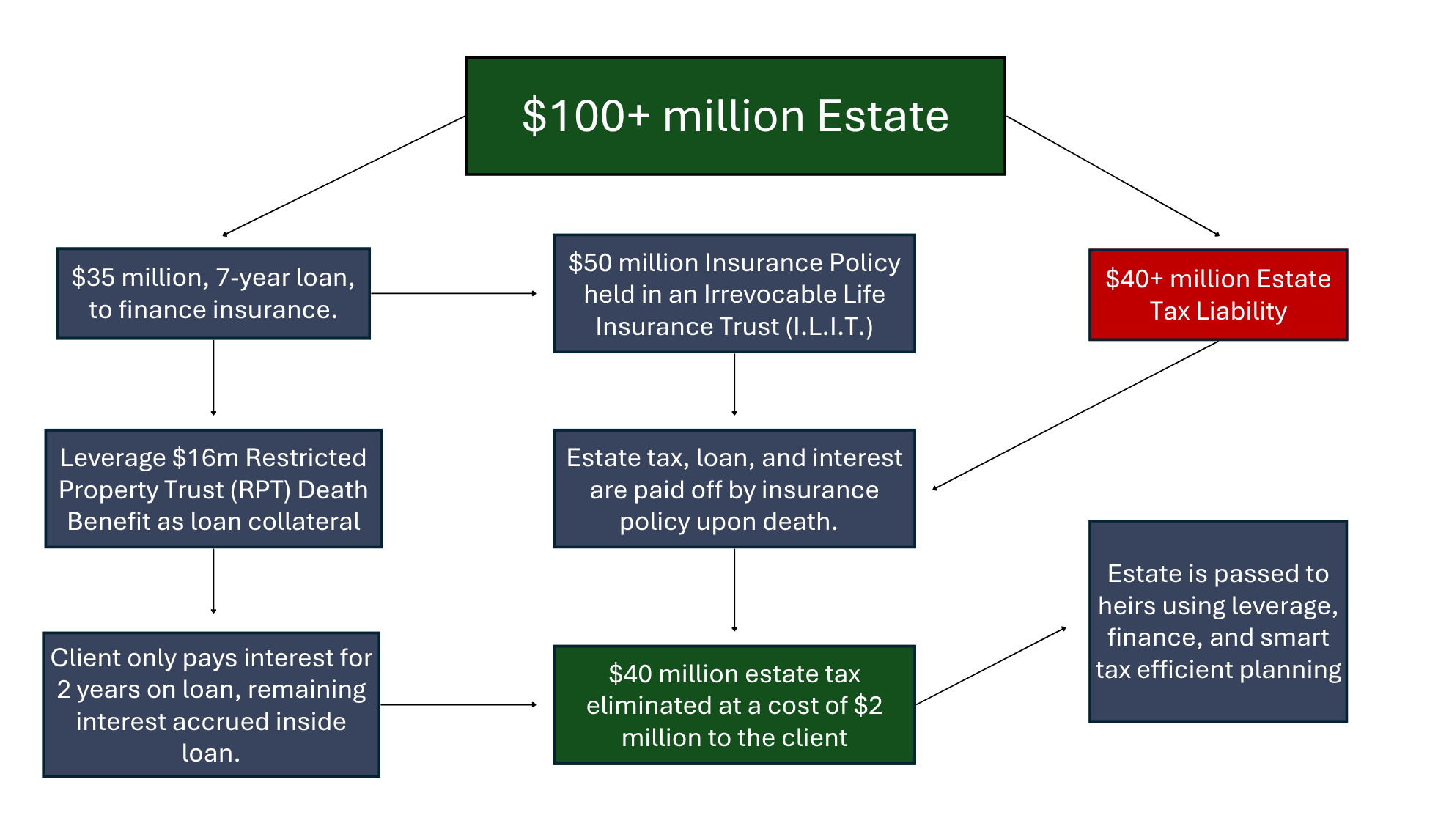
This case study is a continuation of a client’s tax planning utilizing the Restricted Property Trust. To view that case study, please visit our Restricted Property Trust page at the link below.